When most people think about collaboration, they think about teams. And why not? Most of our collaborative experiences involve working with a relatively small group of people.
But collaboration doesn’t end with teams.
As organizations grow, we typically assume we must replace collaboration with a hierarchy based on top-down authority. We divide people into teams, appoint managers to coordinate them, and build layers of authority to coordinate increasingly larger groups.
The Hierarchy of Circles offers another possibility.
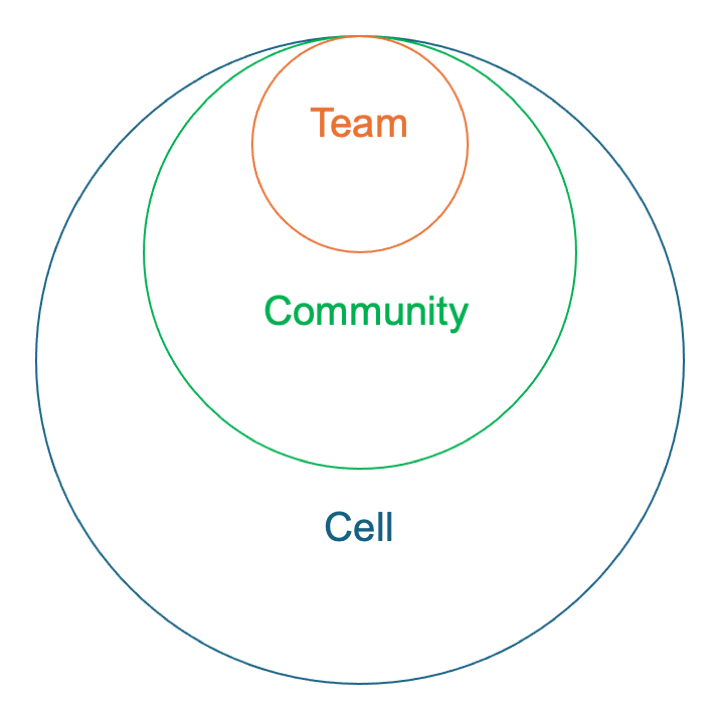
By organizing people into a hierarchy of nested circles, each with a distinct purpose, organizations can coordinate increasingly larger groups while remaining grounded in collaborative principles.
Team
A team is the foundational circle united by a common objective and shared commitment to one another. Together, members accomplish meaningful work while building the relationships that sustain effective collaboration.
Community
A community is the coordinating circle that brings multiple teams together around a broader purpose. It coordinates the work of those teams while strengthening the shared values that connect them.
Cell
A cell is the stewarding circle that connects multiple communities united by an enduring purpose. Rather than directing work, cells preserve the shared values, identity, and conditions that allow collaboration to flourish over time.
Organizational growth does not simply mean building bigger teams. It requires new interconnected circles with different purposes.
- Teams focus on accomplishing work together.
- Communities focus on coordinating teams working toward a broader purpose.
- Cells focus on stewarding the long-term health and development of the collaborative system.
Together, these circles form a nested architecture that allows collaboration to scale without relying on increasingly complex hierarchies of top-down authority.
Collaboration is not limited by size. It is limited by design. The Hierarchy of Circles provides a framework for organizing increasingly larger groups of people without abandoning the principles that make collaboration effective.
The CirclesNDots Framework is a collection of interconnected design principles that together describe a scalable, collaborative approach to organizational design.